Saturday, December 4, 2010

Book Review: Sex, Sin & Zen


I heard of this book through a Buddhist blog I casually read - and thought the concept was very interesting. Brad Warner, an ordained Soto Zen Priest, promises to provide, "A Buddhist exploration of sex, from celibacy to poluamory and Everything in Between". I gave the book a casual scan in the bookstore - seeing the title next to some other of his books, and it seemed to ask some interesting questions; for example: can monks masturbate?, what is the buddhist attitudes towards abortion?, is pornography a bad thing?

I picked it up based more out of curiosity than anything else - and it would be nice to get back on a Buddhist reading kick. Lately I've found myself heavily entwined with taoism and varying philosophical works by the likes of David Foster Wallace and Henry David Thoreau.

This book blew away every expectation I had of it right from the start. Throughout the book, Brad discusses the heart of buddhist philosophy and history with amazing clarity. His approach is very honest, and he does not separate his discussions from own history and feelings. Throughout the book you get a very lucid taste of his view on things - and he does not abuse this by saying you should believe him. I guess in a way you can call this a sneaky book at times - it uses sex more as a tool in order to discuss much more poignant spiritual and philosophical matters, for example:

The idea of avoiding preferences doesn't mean that we need to be complacent and leave even the worst situations in life just as they are. The first step in effectively changing something that clearly needs to be changed is accepting the way it actually is. Then we can do what needs doing to make things different without wasting a lot of energy wishing things already were different. - Pg. 201

This book not only made me consider aspects of sexuality and relationships, but really helped clear up a lot of spiritual misconceptions and issues I had with my prior inquiries into Buddhism and Zen. Brad does a fantastic job of distilling extremely complex issues in such a way that the reader can come to their own conclusions and be okay with them. I didn't agree with everything he writes in the book, but the honesty of the discussions in the book provided a framework for me to understand other sides of the issues and philosophies.

I am very thankful I picked this book up off the shelf...I feel that it's helped me put a lot of complicated issues from my own light into a very manageable perspective. It's allowed me to be more open and honest with my own thoughts and emotions - and not just in regards to sex, but with religion, philosophical inquiry, relationships, politics, social constructs, and living compassionately.

All that being said, I don't think I'd recommend this book to anybody. People need to come to this book with a very open mind - and be comfortable going into some really heavy subjects like abortion, homosexuality, celibacy and polyamory. I do think it's a fantastic book for someone interested in sexuality and Buddhism. I was very intrigued at how Brad writes in such a way that you don't need to have studied tons of Buddhist texts to understand the keys of the philosophy. It's a far better starting point than many of the books on Buddhism I've already read.

- Chris

Political Compass

I was doing some research for a project via the all-knowing Wikipedia, and came across something called a political compass.


I'm sure this isn't anything new for most people, but for someone who tends to keep his neck far clear from anything overtly political - it was interesting. I read into it, and took a "where do you stand" test HERE.

Anyway, the test is awkwardly written, with lots of negative clauses thrown in there to keep you on your toes. I'm sure those that aren't paying attention may answer the opposite of their intent...so I was a bit skeptical to say the least. Regardless, I slogged through the questions out of sheer procrastanistic curiosity. The conclusion of the test shows where some "popular" political figures would fall in this chart:


And then, my results:


While I find it hard to argue that this is pretty accurate, no test or chart can speak for what you believe in. I think it's tests like this that give tools to shape their egos, and lead to close-mindedness...and that's dangerous. In one year or ten, I could take this same test, and I have to keep open-minded enough to realize that it may change. People too often get comfortable being in a particular "camp", and this prevents them from seeing the perspectives of those on the other side of the fence. Maybe this just shows my weak knowledge of the subject, but it was certainly an interesting exercise regardless.

Saturday, November 27, 2010

NYC Haiku

It's around 3am...just got home a half hour ago from a few days with family - and I have to head out in 2 hours to a friend's wedding in Cape Cod...so rather than sleep I've been frantically trying to get everything in order for the second trip. I've settled down now...but on the trip home I had some time to sit and muse - and I share with you some new york city haiku's:


city never sleeps
nights kept busy in odd ways
want to go to bed

===============================

why be so crazy
don't flip out on that cabbie
he is off duty


nyc really is quite ridiculous at 2 in the morning, then again - so am I :)

- Chris

Saturday, November 20, 2010

Movie Review - The Man From Earth

"Piety is not what the lessons bring to the people, it's the mistake people bring to the lessons."

On a whim, I recently watched The Man From Earth (2007) on Netflix Streaming. (Speaking of which - for ~$10 a month this is such a phenominal deal - and the primary reason I don't have to spend ~$100 a month on cable)

While I'm not one to write a review of every movie I watch - this one is certainly an exception. Written by sci-fi legend Jerome Bixby, The Man From Earth is a story about an impromptu good-bye party at the almost-empty house of Professor John Oldman; which quickly turns into an interrogation about the reasons he's leaving. After plenty of goading John reveals that he is in fact a cro-magnon human who is about 14,000 years old, and never ages. Understandably, his colleagues label it as a prank; but of course an anthropologist, biologist, historian, psycologist, and the other academics couldn't let such an idea pass.

The film goes into an astounding amount of discussion involving the physical possibilities of John's condition, and probing of John's memories of his many many years and life experiences. At every question, John provides lucid and entertaining responses - constantly putting his colleagues (and the viewer) into a state where they have to seriously consider that he's in fact completely serious. I knew it was a movie, yet I found myself wanting it all to be true, because the plotline of this 14,000 year old life was so compelling.

I've often fantasized about the possibility of living in a different era - what life would be like in many different types of societies and cultures...and the film goes into quite a few of John past "lives" with a breadth and depth that is incredibly entertaining. The back-and-forth among the other characters in response to John's revelation continuously discuss and reinforces the notion that it is possible (nay, important for a truly curious mind) to investigate phenomenoa without having to believe in it first. (And this is a point that is not stressed enough in education these days!)

The film gets very emotional and touchy in the latter half, when the discussions about faith, religion and philosophy are strongest - but the film does so in such a fantastic way. By far, this was my favorite parts of the film. Ellen Crawford does a pretty decent job at portraying Edith, a christian fundamentalist who gets extremely uncomfortable and withdrawn as some incredible secrets about christinaity are revealed by John. She walks the finely woven line John unravels just enough to have her firm resolve and rejection of the idea into an almost incredulous belief that it may actually be the truth.

The film is a bit reminiscent of 12 Angry Men, given it is shot entirely in John's cabin, and the movie is focused solely on the characters and John's story. The film brilliantly uses the house as a way to break up the pace of the film, to allow for some decompression and setup of changing angles of inquiry. It also provides opportunities to focus on the characters grappling with the issue of whether to believe John or just hear him out while he's outside.

The acting in general is pretty good, David Lee Smith plays a very convincing John Oldman - and his speech is fluid, clear, and spoken with incredible sincerity and pace. If was a pleasure hearing him speak through pages and pages of script as if he truly was the person who experienced it all.

All this being said, the film has some weak points. Harry's jokes a bit dorky and lame, but actor John Billingsley does a pretty good job of saving those moments being sincere and affable while saying the lines. William Katt needs some acting lessons after witnessing his role as Art, and the ending...the ending was fan-tas-tic, but it was a bit quick and brief. It was such a fun, brilliantly written way to end the film, but the director kind of screwed the pooch in the execution. Not that is was bad...you just know if could have been a lot better.

I give this movie a 9.5/10, losing a half a point for the 2 points mentioned above, and reccomend that you SEE THIS MOVIE!

- Chris

Friday, November 19, 2010

Book Review: Walden

"Will you be a reader, a student merely, or a seer? Read your fate, see what is before you, and walk on into futurity." - Pg. 119

Yet again, I have my friend Eli to thank for introducing me to such a fantastic book. Considered Henry David Thoreau's masterpiece, Walden is a weighty book which chronicles his thoughts and experiences over the course of a couple of years on the banks of Walden Pond during the years 1845-1847. Walden is rife with transcendentalist philosophy, in many ways a response to a world that was growing increasingly hectic and smaller. While written in the mid 19th century, many of the discussions and philosophy is just as relevant to today's world (if not MORE so) than it was in his world - and that's probably one of the biggest reasons the book is considered such a literary classic.

"We are the subjects of an experiment which is not a little interesting to me. Can we not do without the society of our gossips a little while under these circumstances - have our own thoughts to cheer us? Confucius says truly, 'Virtue does not remain as an abandoned orphan; it must of necessity have neighbors.'" - Pg. 144

I'll admit that the book is bogged down by a lot of long descriptions of the natural world Thoreau explored. While interesting, and all eloquently written, it took me quite a bit of time to get through this book. It's the type of book that takes me a long time to read, little bits at a time. (Sorry I've had your book for over a month Eli :-/) While the language is certainly a bit too flowery and poetic for my taste, when he gets to the meaty philosophical parts he presents his arguments with a level of clarity that really made me think about things. The book certainly resonates with my feelings about the world I'm living in.

"We should be as good as the worthies of antiquity, but party by first knowing how good they were. We are a race of tit-men, and soar but little higher in our intellectual flights than the columns of the daily paper." - Pg. 116

It's really hard to classify Walden - in parts its a practical description of living a life in the woods on one's own terms, in others he takes a critical look at society and economy, and in portions his investigation takes a scientific tack that while odd; helped me to appreciate the man behind the book. Thoreau is certainly a man of many facets and talents, and quite resourceful to boot. He is a man who is comfortable with who he is, and wise enough to realize the true battle of mankind is the battle within.

"A single gentle rain makes the grass many shades greener. So our prospects brighten on the influx of better thoughts. We should be blessed if we lived in the present always, and took advantage of every accident that befell us, like the grass which confesses the influence of the slightest dew that falls on it; and did not spend our time in atoning for the neglect of past opportunities, which we call doing our duty." -Pg. 330

While Thoreau openly discusses his experiences with eastern philosophy, many of his discussions echo Buddhist, Taoist and Hindu philosophies - consciously or without knowledge. He does so in a way that is shockingly lucid, considering the limited exposure such philosophies had in the west in his time. It's in these passages where Thoreau's brilliance really shines brightest (for me, at least).

"I think that we may safely trust a good deal more than we do. We may waive just so much care of ourselves as we honestly bestow elsewhere. Nature is as well adapted to our weakness as to o strength. The incessant anxiety and strain of some is a well-nigh incurable form of disease. We are made to exaggerate the importance of the work we do; and yet how much is not done by us! or, what if we had been taken sick? How vigilant we are! determined not to live by faith if we can avoid it; all day long on the alert, at night we unwillingly say our prayers and commit ourselves to uncertainties. So thoroughly and sincerely are we compelled to live, reverencing our life, and denying the possibility of change. This is the only way, we say; but there are as many ways as there can be drawn radii from one centre. All change is a miracle to contemplate; but it is a miracle which is taking place every instant." - Pgs. 15-16

Thoreau was certainly a naturalist at heart. The breadth and depth of his knowledge and experience in such matters becomes clearly obvious while reading Walden. The detail he provides is more than enough to close one's eyes and be able to pretend you're sitting on the stoop of his cabin enjoying a perfect day at Walden Pond. Thoreau also showcases his concern for the decaying relationships between man and nature - how out of touch society was becoming with its powerful benefits. I think if Thoreau were to live in today's world, he'd probably have quite a fit fits over how much worse things got after the Industrial Revolution and two World Wars really gummed things up a whole lot worse...

"But since I left those shores the wood choppers have still further laid them waste, and now for many a year there will be no more rambling through the aisles of the wood, with occasional vistas through which you see the water. My muse may be excused if she is silent henceforth. How can you expect the birds to sing when their groves are cut down?" - Pg. 205

Walden was by no means an easy read, but the challenge was well worth it.

- Chris

Tuesday, November 9, 2010

MapCrunch


I found out about this gem of a website today: MapCrunch.

It distills the entire google maps photo database and transports you to a random place in the world (and you can set some of the parameters if you've got a specific place in mind). I't s a great reference tool to get a landscape to practice drawing...but it's also nice to be inspired. For instance, I want to go climb the rock in the picture above and play with those penguins. Which means I'll have to go to Antarctica!

- Chris

Sunday, November 7, 2010

"It's a long way to the top / If you want to rock & roll"

This is merely one viewpoint of an awesome weekend trip. For the other view, check out Mike's blog posts here: HERE and HERE.

Partially inspired by my recent trip to Mt. Washington, Mike tossed around the idea of doing a weekend hiking trip. Having no plans other than hosting a halloween party friday and antsy to leave the city for a while - I signed on to the plan pretty quickly. After debating the logistics of a trip to the Catskills or the Adirondacks further upstate, we chose the former. It meant only staying over one night, no time off work, and a quick 90 mile drive to and from the Catskills.

I picked the rental car up around 10am Saturday, drove up to Fort Washington to pick up Mike - and we headed north on I-87. Shortly after crossing the Tappan Zee Bridge we detoured to the Eastern Mountain Sports in Nanuet. I needed a new pair of hiking shoes to replace the ones I destroyed on Mt. Washington two weeks ago. We continued up I-87 to the exit for Rt. 28, which would lead us directly into the Catskills.

While it was past peak-leaf season, there was still plenty of color left on the hills and mountains. The last remanants of orange and red were intersperced with patches of evergreen, bright yellows and bare branches. Not quite as stellar as New Hampshire two weeks prior, but a heckuva lot better than the forest of concrete I call home. We were both getting hungry - so we decided to find a local place to grab some lunch. We first stopped at this odd Caviar store, whose promises of "gourmet food" left much to be desired. The store did feature some pretty large, impressive wooden dioramas of caviar harvesting. According to the owner, they help to sell the caviar.

A bit further down the street we stopped at Bistro-To-Go, a good bet because there were a bunch of cars parked around it. Inside was a hip little bistro with a friendly staff filled with some good smelling food, which turned out to be just as tasty as it smelled! We continued on the road another couple of miles until we got to Boiceville. Here, our attention was peeled from the open road by an alien space shuttle, and tons of spacecraft off the side of the road. We agreed we had to stop and check this out, so I turned the car around and we walked around in awe of the sculptures of artist Steve Heller. He makes his sculptures out of scrap metal, old car parts, and plenty of woodwork. He even created a replica Stargate out of car parts!

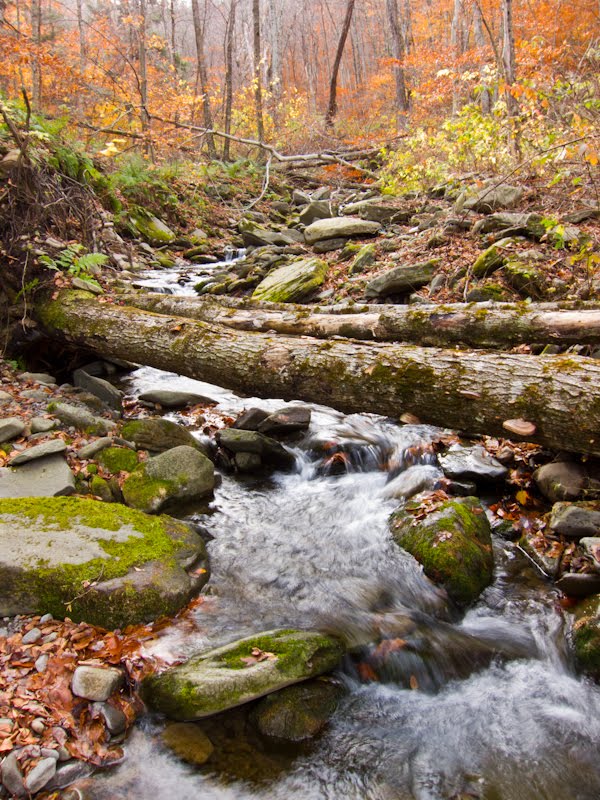
We realized that since it was still pretty early, and it was such a nice day - we should do a quick little day hike to explore the area. We found the Fox Hollow Trailhead, and explored along a fun little steam, full of boulders and fallen trees.


A little ways up Route 28 we came to the small town of Pine Hill, NY. A very small "town", there was nothing of interest until we came to our resting place: The Colonial. Words can't truly capture how...strange the place was. Thankfully Mike takes a ton of pictures:

Mike's Colonial Inn Photo Gallery

The place had a feel like a packrat's heaven - tons of mismatched furniture, hunting paraphernalia on the walls, hunting targets on top of firewood, jukebox on the front porch, and even a random stuffed Mickey chilling out at the bar:


While the locals were certainly interesting, we were welcomed and made to feel as comfortable as you could feel with all the animal heads mounted on the wall. We partook of the "grand buffet", which was actually much better than we thought it would be. That's a good thing considering we almost lost our appetite looking at our waitresses teeth. Her mouth looked like black bean soup...but I bet the nearest dentist is a long drive away and she probably doesn't get dental when they're charging only $14 for an all you can eat buffet.

We spent the rest of the night going on a drive for provisions for the hike, packing our bags and hitting the hay. We got up around 4am, and made the short drive to our trailhead. We set off about a quarter after 5am - ready to reach the top of the first peak, Wittenberg Mtn.

For the sake of brevity I've decided I will leave out the details about the hike itself - Mike's already done it really, really well anyway. So, I've decided to take a different tack...

I find myself in a much more awake and vibrant state when I'm in the nature. Perhaps its just so noticeable because I live in an enormous city, so when I go on a hike or climb it tends to be feel a lot like jumping into a pool of ice water. With every step, there a much greater sense of immediacy and interconnectedness. Throughout a hike the woods reveal themselves, and therefore do their part to reveal "me" to myself. My mind doesn't wander so much and a very true sense of peace settles over me.

View from the top of Wittenberg Mountain, 8am


There was definitely a sense of accomplishment in reaching the top of any mountain, or in finishing a particularly difficult hike (15 miles in 10 hours). But what really matters is the journey you take to get there - and I feel very lucky that I'm able to enjoy those journeys so much more now. When I sit on top of a mountain making peanut butter and honeycrisp apple sandwiches, I am completely comfortable with myself and my surroundings - I realize it's all a singular experience and it makes me a very happy man indeed.

Since pictures are worth thousands of words: Mike's Complete Hike Gallery

- Chris

Thursday, October 21, 2010

Mount Washington

"This is close to the idea of God as I've ever been" - Chris
"Take a step to the right and you'll be a whole lot closer" - Eli


When Eli proposed a group hiking trip to Mount Washington, I was torn. My shoulder was feeling better, but still nowhere near fully healed - but having done nothing physical for 2 weeks, my mind and body were absolutely screaming for something to do. While I received quite a bit of unsolicited advice telling me "chill out" and "relax", I'm not about making up excuses to not have amazing adventures. I was totally bummed that I missed the last hike 2 weeks ago (right after I had my shoulder separated), so I simply couldn't pass up an opportunity to get out to New England for the weekend. If you've never been up there in the middle of October - you're missing out on the amazing colors of the trees, crisp clean air, and coffee shops every hundred feet.

Friday night was spent with friends in Rhode Island - a few games of Dominion followed by Thunderstone. We got to bed early, and woke up Saturday at 5:15. Eli and I were ready to go from the start, and after much wrangling of our crew of adventurers - we were headed up to the White Mountains of New Hampshire, a roughly 3.5 hour ride north. It was fun driving through Kingston, Warwick, Providence and Boston - places I haven't been to since college. I still miss New England, and after having left 5 years ago, part of me will always toy with the idea of moving back at some point.

We got to the foot of Mount Washington around 10:30 - and our crew of six geared up for the hike. The weather reports called for 1-3" of mixed precipitation, winter conditions, avg. winds at around 50 mph on the summit, gusting to high 60's, and a wind chill of -1 deg. F. I should note here form the start that this report was created my the Mount Washington Observatory (MWOBS), who monitor conditions constantly from a huge observatory at the summit.


We were well prepared with winter wear, snacks, and water - so onwards and upwards we went. Our plan was to tackle the Tuckerman Trail, a 4.2 mile hike each way to the summit, with about 4900 feet of elevation gain. The weather at the base was gorgeous, low 50's, and a light mist in the air. There were plenty of small waterfalls and steams at the start of the hike, and plenty of photos were taken. At this point, Eli and I decided that with the pace the crew was taking (admittedly slow), we would never make the summit in time, so we left our comrades and booked it up the mountain. It was a tricky hike, as we were basically navigating a ravine full of small boulders - so footing was very important. Gradually the weather got slightly colder, but it was fantastic in every way because you're heating up with all the hiking - so we were comfortable all the way up to the caretaker's cabin roughly halfway through the trail. We left word for our crew that they could drive home without us (as we took 2 cars up for this very reason), and set on.

The weather around this point started to get really interesting, as the snow started as just faint wisps in the air:


to light accumulation:


to pretty constant accumulation:


At this point we were reaching the top of the tree line, and we donned our winter gear. We were at the bottom of the mountains head wall, so we were still shielded by the winds. We were greeted to an awesome waterfall, courtesy of the melting snow and apparently not a regular sighting along the Tuckerman Trail. At this point all that lie ahead of us was rock, snow, ice and heavy wind. The ascent become increasingly difficult, as we had to navigate much slower and carefully - especially in my case as I could really only use one arm.


This video was taken at the bottom of the head wall we were about to tackle. At 10 seconds of the video, the plain white area is actually Mount Washington, it's covered in thick fog.

As we entered the Arctic Zone, the winds really picked up now, and the ground cover was anywhere from a few inches to a few feet, and it was a small victory to make it to each stone cairn - which served as our trail markings. At this point in the ascent, the wind was blowing fiercely into our faces, driving snow into our eyes, so each step became harder and harder. At the same time we were contending with poor footing. There were portions where we simply had to get on our hands and knees and crawl past some sections. And boy, did it get cold. However, Eli and I refused to give up even though our energy was getting sapped with each step. We refused to yield to whatever Mount Washington was throwing at us. If conditions had been any worse, we probably would be forced to head back down...but as we got about 0.6 miles from the summit, we realized it would be much safer to reach the summit, go into the observatory building to warm up and change into dry clothes than to turn around and head back freezing our butts off.

An hour later, we approached summit and the feeling was absolutely amazing. Eli and I were pretty jubilant, but at the same time - we both knew that we couldn't enjoy the moment for long. Winds at the top of the mountain were peaking at 70mph, and the snow was very significant and everything around us was caked in thick layers of ice. Visibility was extremely poor and we had a hard time finding the right building. After 10 minutes of searching frantically among the high winds - we found the right door - and entered to a the dimply lit ranger station. We were greeted by 2 other hikers, and some unfriendly rangers - who made it quite clear that what we did was a pretty poor idea all around - and we didn't look all that prepared. One guy in particular was pretty gruff about the whole idea - and wasn't afraid to put some fear into us - and to be honest I can't really fault him. I'm sure he's seen some pretty messed up stuff on the mountain - but that being said it didn't exactly help to imbue any confidence on those going to head back down the mountain.

After thawing out (Eli's beard was frozen solid), refilling our water and changing our socks, we looked over the topographical map of the mountain with the rangers. We had 2 problems - tackling the rough weather, and daylight. The ascent took us about 4.5 hours, and the late start means it was about 3:30 and we had about 3 hours of light left. The ranger presented us 2 options:

A) Go down the Mt. Washington car road.
This involved an extra 4 miles of hiking, then a 2.5 hour hike through the woods back to our car - in total darkness. In addition, the majority of the road was covered in thick ice and completely exposed to the 50 to 70mph winds we got blasted by on the summit. The advantage here was clearly on the ranger, who could search for us by car should we never get down to the cabin.

B) Go back down the way we came.
We thought about it, and realized it would be a trickier hike, but we could go down the steeper, shorter, but rougher Lion's Head Trail. It provided the quickest decent vertically, but would involve some very rough terrain. We decided to go down this route.

The first 0.4 miles of the way back involved the same route we took up the mountain, which took us around 45 minutes of intense effort. Luckily for us, going back down was WAY easier. The fact that there was a thick snow and ice cover allowed us to sled down big swaths of the route on our butts, as long as we were careful to take it kind of slow and avoid the rocks. It was actually a lot of fun, and it took us all of about 10-15 minutes to get to the cairn which marked the trailhead for the Lion's Head Trail. As an added bonus, all of the snow I accumulated on my frozen jeans from the sledding actually acted as an insulating layer and my legs warmed up. (Wearing jeans was not a good idea in general though)

The Lion's Head was amazing. As we were really moving as fast as we could (burning daylight, after all) - we took very few pictures after this one:


For part of the trail, we were actually walking the ridge line of the mountain, and the setting sun cast a gorgeous glow over the snow and ice. It was here where the quote from the start of this post came from. The weather was still windy and vicious, but we were in very high spirits and enjoying the journey. The path down involved a lot of tricky bouldering and poor footings - but we were able to make it back down to the end of the trail just as dark enveloped the mountain.

It was an epic journey - and definitely one of the most arduous things I've ever done. Physically I was sore, but my shoulder, and the remnants of the cold I'd had for weeks were significantly healed - something I credit to the energy of the mountain, and some well spent time in nature. It really beats the crap out of life in the city - and the trip helped to solidify the notion that I should be spending far more time out of it.

- Chris

Monday, October 4, 2010

Pop!

Haven't updated in a while, as I've been dealing with an unfortunate grappling incident. Last Tuesday I was rolling with a guy near the end of class, and got into an awkward position. My arm was trapped across my chest, and at the same time my balance was reversed. His weight, plus my own ended up being thrown straight down towards the mat. I managed to land directly on my right shoulder - resulting in a resounding POP!

A searing amount of pain shot through my shoulder, and after moaning and groaning for a bit I was brought off the mat and given some ice. Apparently my AC ligament was probably damaged...a common grappling injury I'd never heard about before. After some help changing into half my street clothes it was off to Lenox Hill's ER in a cab.

After some X-Rays, I was diagnosed with a 3rd degree AC shoulder separation:


Basically the ligament that holds the shoulder joint to the clavicle is badly damaged, causing the shoulder joint to drop. Basically, the shoulder itself works pretty well, but certain angles and movement cause that ligament to scream in pain - so I have to keep pressure off of the shoulder...i.e.: in a sling.

I'll know more on Wednesday what the extent of the damage is - but it will hopefully heal on its own in a few weeks, then some physical therapy will hopefully get me back to normal.

I'll update with good news soon!

- Chris

Wednesday, September 15, 2010

Book Review: Consider The Lobster

BOOK: Consider The Lobster - David Foster Wallace

HOW I FOUND THE BOOK: My friend Eli was kind enough to introduce me to DFW, mainly due to his philosophical proximity to several other writers I closely identify with. In a lot of ways, DFW tends to be a modern-day version of Alan Watts. I had read a transcript of the only speech he ever gave, titled This Is Water...and to say I was very interested would be an understatement.

--

Consider The Lobster is a collection of various essays and articles written by DFW that cover a broad range of topics. The articles in the book are original uncut versions of articles that were originally published in magazines. All provide a level of journalistic depth and breadth that are truly masterful. The stories elicit many thoughts, emotions - but they are often presented in way which causes the reader to react in their own way. The reactions are not spoon-fed by DFW, who though he may be very clearly a genius of the highest order (which he very clearly is) - he does not take his audience as idiots. His ability to put you in the situation is uncanny, and the scope of his description and reasoning were true eye and mind openers with regards to "connecting the dots" of many different aspects of our culture and our place within it.

The only real issues I had with the book stemmed from his enormous penchant for footnotes...which break up the flow of his prose with regularity (mostly due to the fact that they're all definitely worth reading, and on occasion are the true meat of the article). It's also handy to have a dictionary on hand - DFW's vocabulary is simply astounding.

The subjects of DFW's prose are so widely varied, yet they are all somehow treated objectively - to the point where the reader has no other choice but to open their mind to the nature of his experience. DFW's presentation of his subjects goes way beyond the superficial standards of many journalists - and he takes his time in doing so. His ability to paint as clear as possible the subject and the atmosphere of their reality is masterful - and keeps the reader on the aforementioned path to objective observation. Simply put; it's this kind of open-minded investigation that can truly change perception. It's very easy to see or hear something and make a value judgement - this is something we all do pretty much all the time...yet this leads me to think that maybe the time granted to an author by forcing his audience to read in a sequential order is to their advantage.

Consider The Lobster has definitely given me a much wider perspective on politics, philosophy, linguistics, talk radio, and so many aspects of American culture - but most of all I feel I have a wider perspective of human nature...and I that's the real gift in reading Consider The Lobster.

- Chris